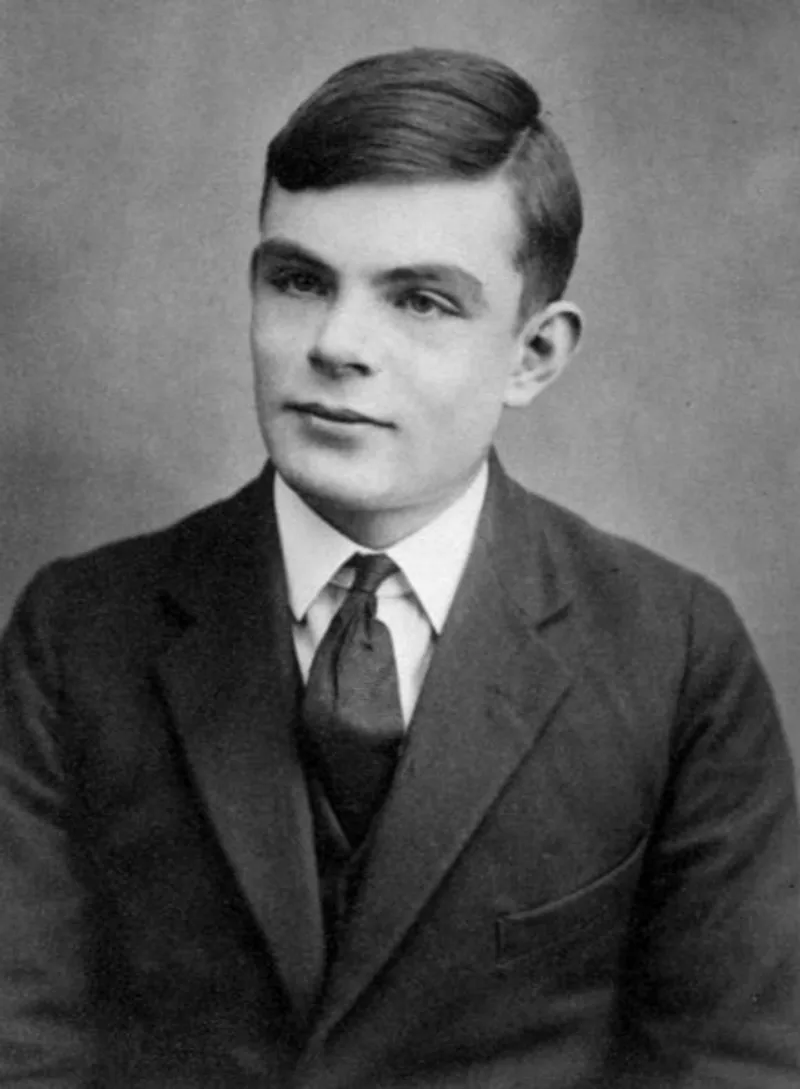
Alan Mathison Turing (1912–1954) was a British mathematician, logician, and cryptanalyst who is widely regarded as the father of theoretical computer science and artificial intelligence. His 1936 paper introducing the Turing machine provided the mathematical foundation for the modern computer, while his wartime codebreaking work at Bletchley Park helped defeat Nazi Germany.
Early Life and Education
Born in London, Turing showed exceptional mathematical ability from childhood. He studied at King’s College, Cambridge, where he was elected a Fellow at just 22 years old—a remarkable achievement for someone so young.
At Cambridge, Turing encountered the Entscheidungsproblem (decision problem), a foundational question in mathematical logic. His approach to this problem would revolutionize our understanding of computation.
The Turing Machine (1936)
In his groundbreaking paper “On Computable Numbers,” Turing introduced an abstract computing device now called the Turing machine[1]. This simple theoretical construct—a tape of symbols, a reading head, and a table of rules—could compute anything that is computable.
More remarkably, Turing proved that a “universal” machine could simulate any other Turing machine, given the right program. This insight anticipated the stored-program computer by a decade and established the theoretical basis for all software.
Bletchley Park and Enigma
During World War II, Turing worked at Bletchley Park, Britain’s secret codebreaking center. He led the effort to break the German Enigma cipher, developing the Bombe—an electromechanical device that could test millions of possible settings[2].
Turing’s codebreaking work was critical to Allied naval victories, particularly in the Battle of the Atlantic. Historians estimate his contributions shortened the war by two to four years, saving millions of lives.
Computing Machinery and Intelligence (1950)
After the war, Turing turned to the question of machine intelligence. His 1950 paper “Computing Machinery and Intelligence” proposed what became known as the Turing Test[3]: a machine could be considered intelligent if a human interrogator could not distinguish its responses from those of a human.
The paper opened with the provocative question, “Can machines think?” and launched the field of artificial intelligence.
Tragic End and Legacy
In 1952, Turing was prosecuted for homosexuality, then illegal in Britain. He was convicted and subjected to chemical castration. He died in 1954 at age 41, from cyanide poisoning in what was ruled a suicide.
Turing received a posthumous royal pardon in 2013, and in 2021, his image appeared on the Bank of England £50 note. His legacy endures in every computer, every algorithm, and every AI system—all built on foundations he established.
Sources
- Stanford Encyclopedia of Philosophy. “Turing Machines.” Explanation of Turing machines and their foundational role in computer science.
- Bletchley Park. “Alan Turing.” Details of Turing’s wartime codebreaking work.
- Wikipedia. “Computing Machinery and Intelligence.” Overview of Turing’s influential 1950 paper on machine intelligence.