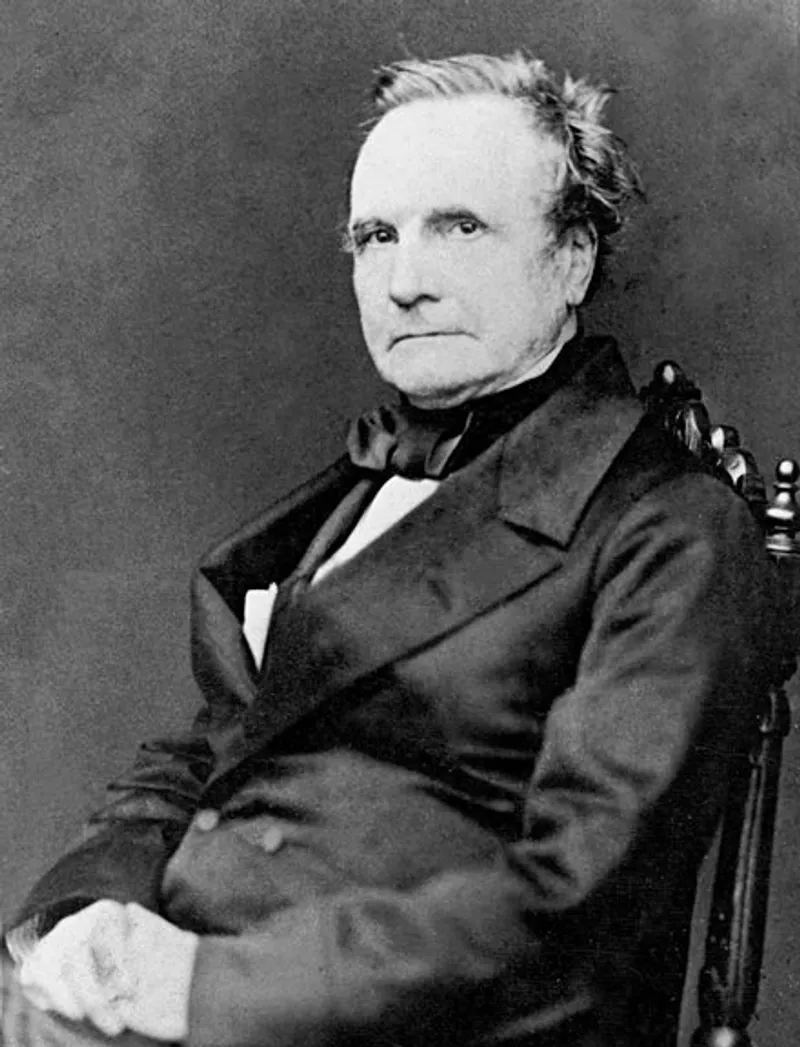
Charles Babbage (1791–1871) was an English mathematician, philosopher, and inventor who originated the concept of a programmable computer. He is credited with designing the first mechanical computers—the Difference Engine and the Analytical Engine—earning him recognition as the “father of the computer.”
Early Life and Education
Born in London to a wealthy banking family, Babbage showed early mathematical talent. He entered Trinity College, Cambridge in 1810, where he found himself more advanced than his tutors in mathematics. Along with John Herschel and George Peacock, he founded the Analytical Society to promote continental mathematics in Britain.
Babbage was elected a Fellow of the Royal Society in 1816 and later became Lucasian Professor of Mathematics at Cambridge in 1828—the prestigious chair once held by Isaac Newton.
The Difference Engine
Babbage’s journey to computing began with frustration. In 1821, while checking astronomical tables with Herschel, he was exasperated by the numerous errors and exclaimed, “I wish to God these calculations had been executed by steam.”[1]
This led him to design the Difference Engine, a mechanical calculator that could tabulate polynomial functions automatically. The British government funded the project, eventually spending £17,500—equivalent to the cost of 22 steam locomotives—but the machine was never completed due to disputes with his engineer and Babbage’s perfectionism.
The Analytical Engine
After the Difference Engine project stalled in 1833, Babbage conceived something far more ambitious: a general-purpose programmable computer. The Analytical Engine, first described in 1837, incorporated:
- A “Store” (memory) capable of holding 1,000 fifty-digit numbers
- A “Mill” (processor) for arithmetic operations
- Punched cards for programming, borrowed from the Jacquard loom
- Conditional branching and loops
This architecture—separating memory from processing—anticipates the design of modern computers by over a century[2].
Collaboration with Ada Lovelace
Babbage’s most fruitful intellectual partnership was with Ada Lovelace, whom he met in 1833 when she was just 17. Lovelace understood the Analytical Engine’s potential deeply, and her 1843 notes on the machine—including an algorithm for computing Bernoulli numbers—are considered the first computer program.
Babbage referred to her as “The Enchantress of Number.”
Legacy
Though neither engine was completed in his lifetime, Babbage’s designs were validated when the Science Museum built a working Difference Engine No. 2 in 1991, using only materials and tolerances available in the Victorian era[3].
Babbage established the conceptual framework for programmable computation. Every computer today—from smartphones to supercomputers—builds upon ideas he articulated in the 1830s.
Sources
- Computer History Museum. “The Engines.” Documents Babbage’s famous exclamation about steam-powered calculation.
- Britannica. “Charles Babbage.” Describes the Analytical Engine’s architecture and its influence on modern computing.
- Science Museum. “Charles Babbage’s Difference Engines.” Details the 1991 construction of a working Difference Engine.